

Imagine sitting across from an interviewer or staring into your webcam during a video assessment. The interviewer looks at you, smiles, and asks: "Tell me about a time you had to deal with a tight deadline and unexpected failure."
Your heart starts racing. Your palms feel a little damp. Your mind jumps to five different stories at once maybe your internship, maybe that one group project, maybe something from a part-time job you almost forgot about. You start talking about your college group project, then drift into talking about your demanding professor, then jump back to how your laptop crashed, and suddenly you realize you've been talking for three minutes without actually answering what you did to fix it. The interviewer nods politely, but you can tell somewhere in the last ninety seconds, you lost the thread, and so did they.
This is the classic interview trap: rambling.
When you feel nervous, your brain loses its structure. In fact, if you frequently freeze up or struggle with camera pressure, learning how to overcome interview anxiety is the first big step toward building confidence. The best way to beat those nerves and sound like a seasoned professional is by using a simple storytelling framework called the STAR Method.
What Is the STAR Method?
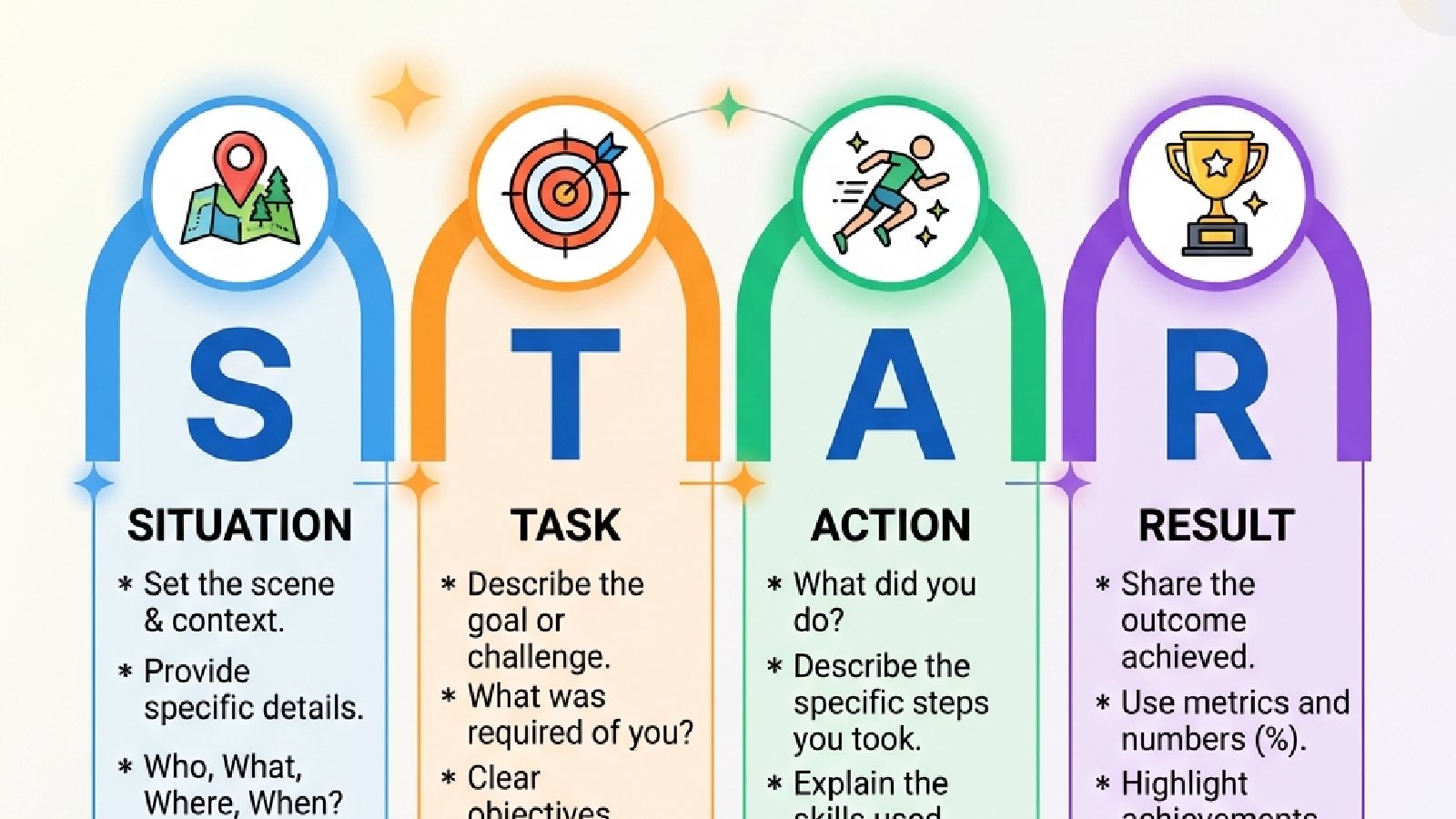
The STAR method is a simple technique that helps you answer behavioral interview questions—any question starting with "Tell me about a time when..." or "Give me an example of..."
Instead of telling a messy story, STAR helps you package your real-life experiences into a clear, four-part story with a beginning, middle, and end.
STAR stands for:
S – Situation (Setting the scene)
T – Task (Explaining the challenge or problem)
A – Action (Describing what you specifically did)
R – Result (Sharing the final outcome and what you learned)
Think of it like telling a good movie plot to a friend. You do not start by explaining the ending credits, nor do you talk about the background characters for twenty minutes. You set the scene quickly, highlight the core problem, show how the hero solves it, and show the happy ending.
The Secret Timing Blueprint: The 15-15-50-20 Rule
Most students and job seekers make one big mistake when using the STAR method: they spend 80% of their time explaining the background situation, leaving almost no time to talk about what they actually achieved.
To keep your interviewers engaged, you should follow the 15-15-50-20 timing rule. In a typical two-minute answer, your time should be divided like this:
Situation (15% - About 15 to 20 seconds) Give just enough context so the interviewer understands the setup. Mention where you were (e.g., college, internship, part-time job) and who was involved. Keep it super brief.
Task (15% - About 15 to 20 seconds) State the goal or the exact problem you had to solve. What was at stake? What was the deadline?
Action (50% - About 60 seconds) This is the heart of your answer. This is where you explain the exact steps you took to solve the problem. Do not talk about what "we" did as a group. Focus on your direct contribution, the tools you used, and how you made decisions.
Result (20% - About 20 to 25 seconds) Finish strong with the outcome. Share real numbers, percentages, or positive feedback whenever possible. Even if the project failed, share what you learned and how it made you better.
Real-World Example: A College Group Project Scenario
Let us look at a practical scenario every student or fresher can relate to: dealing with a team member who vanishes right before a submission.
Question: "Tell me about a time you faced a major obstacle during a group project and how you handled it."
How a Great STAR Answer Sounds:
Situation:
During my final year of college, four of us were assigned to build a web dashboard for our capstone project. Three days before the final presentation, our lead backend developer got sick and could not finish his part of the code.
Task:
We were missing our main database connection, and without it, our dashboard could not display any live data. I had to step in, figure out the missing backend code, and ensure our team met the hard deadline without lowering our project quality.
Action:
First, I scheduled a quick 10-minute call with my remaining teammates to divide responsibilities so nobody panicked. Since I was handling the frontend, I volunteered to spend the night learning the basics of their backend setup using open-source documentation. I reorganized the remaining backend tasks into three smaller steps and worked through the night to write the basic data API connections. The next morning, I tested the code, created backup sample data just in case, and ran a full practice demo with the team.
Result:
We submitted the project two hours before the deadline. Not only did our dashboard work smoothly during the live professor demo, but our project also received an 'A' grade. My professor specifically praised our team's resilience under pressure.
Common Mistakes That Ruin Behavioral Answers
1. Saying "We" Instead of "I"
When talking about team projects, students often say, "We fixed the code, and then we submitted it." Interviewers are not hiring your group; they are hiring you. Always clarify your individual role by saying, "My responsibility was..." or "I decided to..."
2. Forgetting the Quantifiable Outcome
Ending an answer with "And everything worked out fine" feels flat. Try to attach numbers or clear outcomes. For example: "This saved our team 5 hours of manual work" or "This helped us improve our presentation score by 15%."
3. Choosing a Bad Story
Avoid stories where you were completely at fault and learned nothing, or stories where you speak negatively about past professors, bosses, or teammates. Choose stories where you took initiative and showed problem-solving skills.
Practice Delivering Your STAR Answers Out Loud
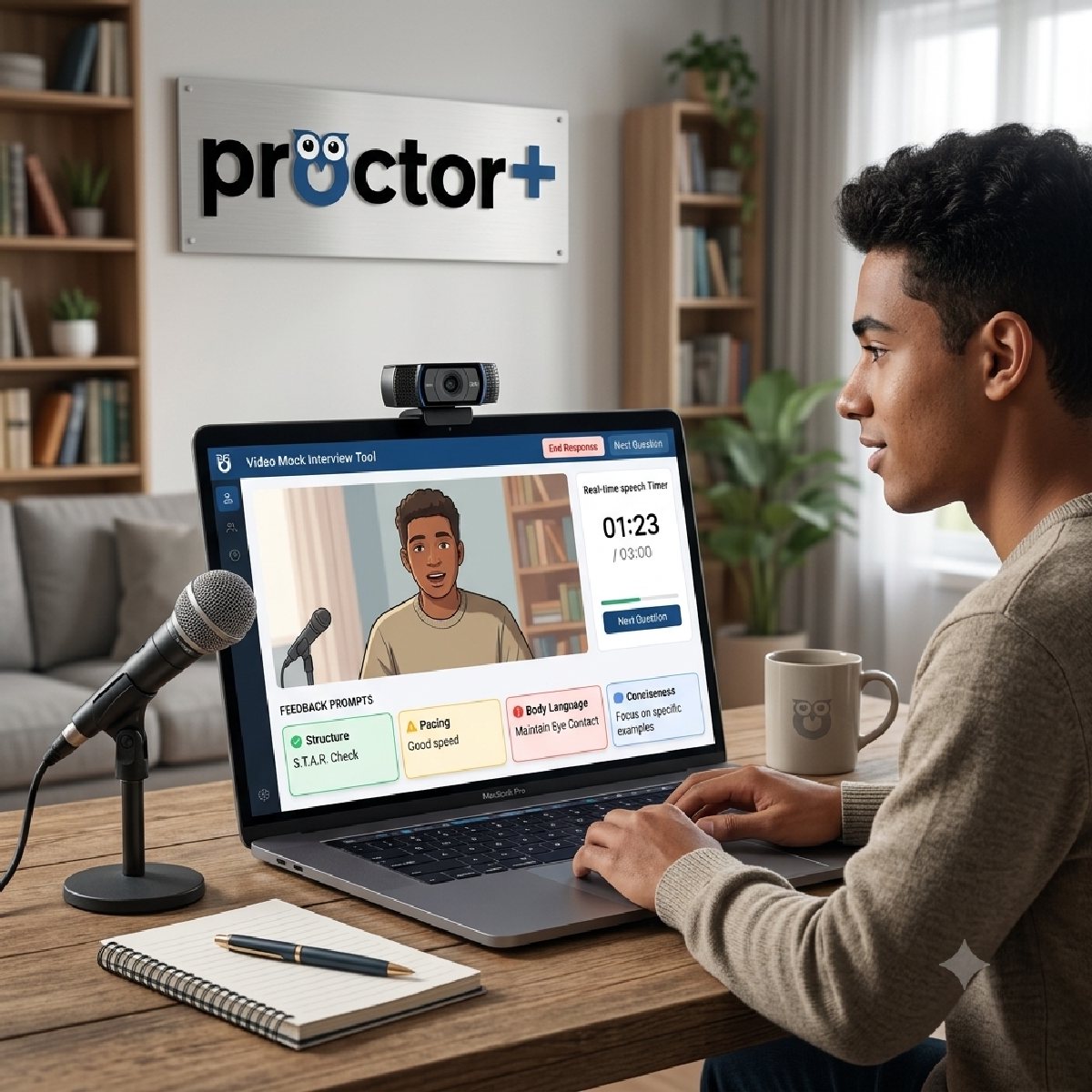
Reading about the STAR framework is easy, but actually speaking your thoughts out loud under interview pressure is where most candidates stumble. You might know the theory, but when the camera turns on or an interviewer looks at you, it is easy to forget your timing and start rambling again.
The best way to build confidence is by practicing your answers under real conditions. Try recording your responses, timing your action phase to make sure it gets most of your focus, and listening back to catch any filler words like "um" or "like."
Whether you are a student preparing for campus placements or an enterprise looking for an AI online proctoring and assessment platform, building structured communication skills is what separates average candidates from top hires. If you are an institution or hiring team wanting a customized platform demo, you can easily schedule a 1-on-1 strategy meeting with our team.
Exclusive Launch Offer: Ready to turn your interview nerves into total confidence? Head over to interview.proctorplus.io to start practicing with realistic AI mock interviews today. Use promo code LAUNCH500 at checkout to unlock your exclusive launch discount and start practicing right now.
Mastering the STAR method guarantees you will never freeze or lose your words in an interview again.
Written by
Riya
Practical guidance from the ProctorPlus interview preparation team.